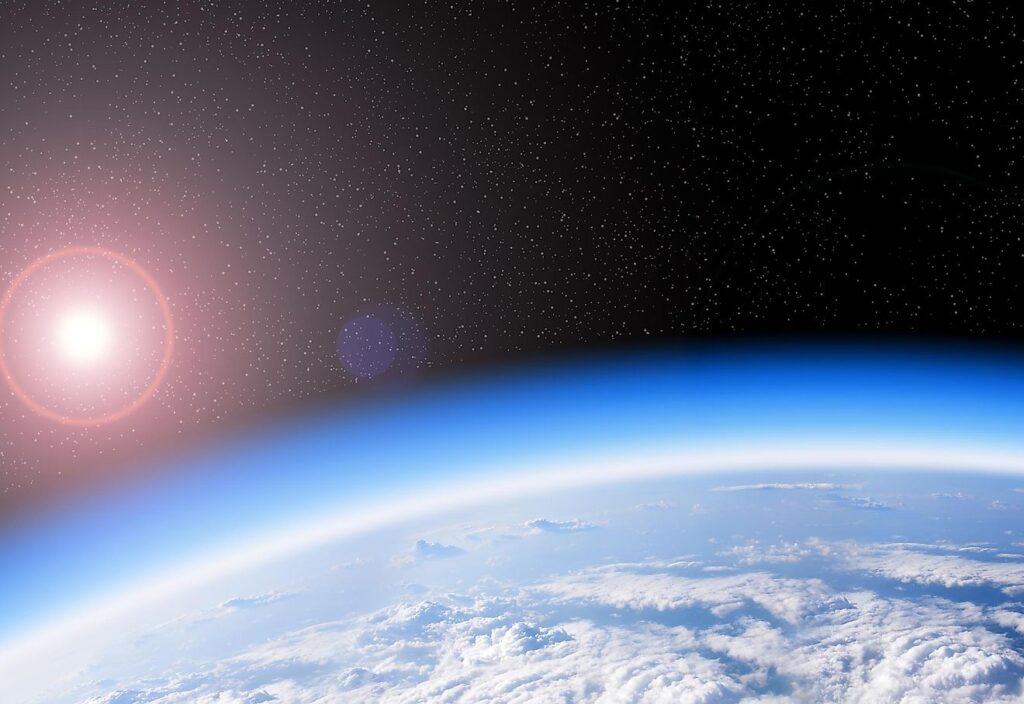
The Earth’s atmosphere is a vast envelope of gases, commonly called air, that surrounds the planet and is held close by gravity. It plays a key role in protecting life and maintaining suitable conditions for survival. This layer not only provides the oxygen we breathe and the carbon dioxide needed for plant growth, but also acts as a barrier that shields Earth from harmful solar radiation, space debris, and extreme temperature variations between day and night.
Composed mainly of nitrogen (78.08%) and oxygen (20.95%), the atmosphere also contains smaller portions of argon (0.93%), carbon dioxide (0.04%), and trace gases like neon, helium, methane, and ozone. Additionally, varying amounts of water vapor—averaging about 1% near the Earth’s surface—contribute to weather and climate processes. These elements together form a delicate chemical balance that sustains all forms of life.
The total mass of the atmosphere is approximately 5.15 × 10¹⁸ kilograms, and about three-quarters of this mass lies within 11 kilometers of the surface. As altitude increases, the air becomes thinner, eventually blending into outer space. Although there is no exact edge, scientists often consider the Kármán line, at about 100 kilometers above sea level, as the boundary between Earth’s atmosphere and space.
The atmosphere is divided into several distinct layers. The troposphere, where humans live and weather occurs, lies closest to the surface. Above it are the stratosphere, mesosphere, thermosphere, and exosphere. Each layer differs in temperature, composition, and function. For instance, the stratosphere contains the ozone layer, which absorbs most of the Sun’s ultraviolet rays, while the thermosphere extends into the region where auroras appear.
Over billions of years, Earth’s atmosphere has changed dramatically. In its early days, it consisted mainly of gases released by volcanic eruptions and cosmic impacts. The development of photosynthetic organisms, such as early bacteria and plants, later added oxygen, transforming the atmosphere into the one we depend on today. However, human activities—like burning fossil fuels, deforestation, and industrial pollution—have disturbed this natural balance, causing issues such as global warming, ozone depletion, and acid rain.
The scientific exploration of the atmosphere, known as atmospheric science or aerology, studies the behavior and composition of air layers. Fields like climatology, meteorology, and atmospheric physics help us understand weather systems, air circulation, and long-term climate patterns. Early scientists, including Léon Teisserenc de Bort and Richard Assmann, made significant contributions by identifying the structure and layers of the atmosphere.
In summary, Earth’s atmosphere is more than just a mix of gases—it is a dynamic and protective system that enables life to exist. It regulates temperature, supports weather cycles, and shields the planet from external dangers. Preserving this delicate balance is vital for the future of all living beings on Earth.
Benefits of the Earth’s Atmosphere
The atmosphere is one of Earth’s most essential natural systems. It provides many benefits that make life possible and protect the planet from harmful outer influences. Below are the major benefits of the atmosphere:
- Supports Life
The atmosphere contains oxygen for humans and animals to breathe, and carbon dioxide for plants to perform photosynthesis. Without these gases, life on Earth could not exist. - Protects from Harmful Radiation
The ozone layer, found in the stratosphere, blocks most of the Sun’s harmful ultraviolet (UV) radiation. This protection prevents skin cancer, eye damage, and harm to plants and animals. - Maintains Temperature Balance
The atmosphere helps to keep the Earth’s temperature steady. It traps heat from the Sun through the greenhouse effect, preventing the planet from becoming too cold at night or too hot during the day. - Prevents Meteoroid Impacts
Most meteoroids burn up when they enter the atmosphere, creating “shooting stars.” This natural shield protects the Earth’s surface from constant space debris. - Provides Weather and Rainfall
The atmosphere enables the water cycle, forming clouds and bringing rainfall. This is vital for agriculture, drinking water, and maintaining ecosystems. - Distributes Heat and Moisture
Air currents and winds move heat and moisture around the planet, balancing climates between hot and cold regions. This keeps weather systems active and supports different habitats. - Creates Sound and Communication
Sound travels through air, allowing communication between people and animals. Without air, there would be complete silence on Earth. - Helps in Climate Regulation
The gases in the atmosphere regulate long-term climate patterns, making Earth suitable for living organisms over millions of years.
conclusion : the atmosphere is not just a layer of gas—it is a life-supporting system that protects, nourishes, and sustains every living being on Earth. Without it, our planet would be lifeless, cold, and exposed to dangerous space conditions.