Over the past few years, India’s startup ecosystem—once hailed as one of the fastest-growing in the world—has faced a dramatic correction. After a record boom in 2021, a wave of startups have closed operations, pivoted, or failed to secure follow-on funding. This trend isn’t random; it reflects a deeper shift in the market, investor mentality, and business fundamentals.
In this article, we explore why many Indian startups shut down after 2021, what factors drove this pattern, and what it means for the future of innovation in India.
1. The 2021 Startup Boom: Start of the Correction
The years 2020 and 2021 saw a massive boom in the startup ecosystem, especially in India. Large amounts of money flowed into startups across sectors like fintech, edtech, healthtech, consumer tech, and logistics. With funding easily available, many startups grew rapidly and achieved unicorn status within a short time.
During this period, investors focused mainly on fast growth and user numbers rather than profits. Startup valuations increased quickly, often based on future potential instead of current earnings. Many companies spent heavily on marketing, discounts, and expansion, believing funding would continue.
However, this approach ignored important factors like profitability and sustainable business models. When global economic conditions changed, investors became cautious. As a result, overvalued startups struggled to survive, leading to a market correction where only financially strong companies could sustain themselves.
2. Funding Winter: The Tough Reality After 2022
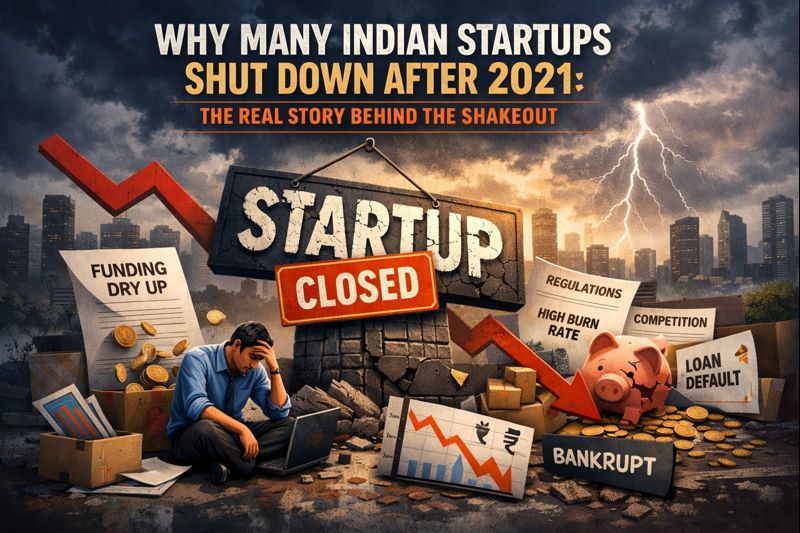
After 2021, many startups began shutting down mainly due to a sharp decline in funding. The easy flow of investment that startups enjoyed during the boom years suddenly slowed down. Investors became more cautious because of rising inflation, global economic uncertainty, geopolitical tensions, and higher interest rates. As a result, less money was available for risky startup investments.
Investors shifted their focus from fast growth to profitability, stable revenue, and lower risk. Startups that once raised funds easily struggled to get follow-up funding. At the same time, high valuations from 2021 came under pressure. When startups failed to meet growth and profit expectations, investors reduced interest or offered funding at lower valuations. By early 2023, this funding winter left many cash-dependent startups with no option but to shut down.
3. Unsustainable Business Models: High Spending Led to Failure
During the startup boom, many companies followed a growth-at-any-cost approach. With plenty of investor money available, startups spent heavily on advertising, discounts, and promotions to attract users quickly. Many also expanded into new cities and markets without first confirming whether there was strong and stable demand for their product or service.
In addition, several startups hired large teams and increased operating expenses without having a clear plan to become profitable. While these actions helped increase surface-level numbers such as app downloads or customer registrations, they often hid serious weaknesses in the business model.
When funding slowed down, these startups could no longer afford their high expenses. Without sufficient revenue or a clear path to break even, they burned through their remaining cash quickly, leaving them with no option but to shut down operations.
4. Lack of Product–Market Fit
One major problem faced by many Indian startups was the lack of proper product–market fit. This means their products did not fully match what customers actually wanted or were willing to pay for. Many startups focused on growing fast before understanding their users deeply.
In many cases, founders overestimated market demand and assumed people would automatically adopt their product. Some startups failed to solve real, everyday problems, while others launched products without enough testing in real-world conditions. As a result, users tried the product but did not continue using it for long.
Because customers did not stay or spend money regularly, revenue growth slowed down. Without stable income and loyal users, these businesses became difficult to sustain. Over time, the gap between the product and market needs made the startup model unworkable, forcing many companies to shut down.
5. Weak Unit Economics: When Costs Were Higher Than Returns
For any startup to survive, the money spent to acquire a customer should be less than the money earned from that customer over time. However, many startups ignored this basic rule. They spent heavily on advertising, discounts, and incentives to attract users, even when those users did not generate enough revenue in return.
Instead of focusing on long-term profitability, startups often highlighted big numbers like total users or gross sales value to appear successful. While these figures looked impressive, they hid the fact that the business was losing money on every customer.
As long as investors continued funding these losses, startups managed to operate. But when funding slowed down, the real economics became clear. Without investor support to cover high costs, many business models failed to make financial sense and were forced to shut down.
6. Sector-Specific Pressures
Many startups shut down because different industries faced their own unique challenges. In the edtech sector, demand grew rapidly during the pandemic as students studied online. However, once schools and colleges reopened, learners returned to offline classrooms, and online course demand dropped sharply. Startups that expanded quickly during the pandemic struggled to survive this sudden fall in demand.
In fintech, especially digital lending, startups faced stricter government regulations, stronger compliance rules, and tougher KYC requirements. These changes increased costs and reduced profit margins, making investors more cautious.
The real money gaming sector was also heavily affected. Higher GST rates and government crackdowns on online gaming platforms increased operational risks and reduced user activity. Due to these regulatory and market pressures, many startups across these sectors found it difficult to sustain their businesses.
7. Intense Competition and Market Overcrowding
After 2020, India saw a sharp rise in the number of startups, with many companies entering popular sectors such as e-commerce, food delivery, quick commerce, and small on-demand services. While these markets looked attractive, they quickly became overcrowded.
With too many startups chasing the same customers, competition became extremely intense. Companies spent more money on marketing and discounts to attract users, which pushed customer acquisition costs higher. At the same time, profit margins remained very low, making it difficult to sustain operations without large financial backing or a unique offering.
New startups found it hard to stand out in such crowded markets. Customers often preferred well-known brands or cheaper alternatives, leaving smaller players with limited growth opportunities. As a result, many startups were unable to survive in highly saturated markets.
8. Talent Challenges
As startups grew rapidly, many faced serious challenges related to talent and team management. Finding skilled professionals in areas like technology, product development, and business operations became difficult, especially for young startups competing with large companies offering better pay and job security.
High employee turnover further weakened many startups. Frequent resignations and layoffs disrupted daily operations and slowed down progress. When startups began showing financial stress, experienced employees often chose to move to more stable organizations, leaving startups with less experienced teams.
In addition, some startups suffered due to weak leadership and poor execution. Without clear direction, strong decision-making, or proper management, teams struggled to perform effectively. These talent-related issues made it harder for startups to adapt to challenges, execute their plans, and survive during difficult times, contributing to the closure of many ventures.
9. Broader Economic and Regulatory Challenges
Even though India’s overall economy stayed relatively stable, several external factors made it difficult for startups to survive. A global economic slowdown created uncertainty across markets, which reduced investor confidence worldwide. At the same time, rising interest rates increased the cost of borrowing, making funding more expensive and harder to access for startups.
In addition, government regulations became stricter in sectors such as finance, data privacy, and online gaming. While these rules were necessary, they added extra compliance costs and operational challenges for young companies. Many startups were already struggling with low cash reserves and slow revenue growth.
Together, these economic and regulatory pressures reduced investors’ willingness to take risks and placed additional burdens on startups. For companies without strong financial foundations, these challenges became overwhelming, contributing to shutdowns across the startup ecosystem.
10. A Market Correction, Not a Collapse
Although many startup closures made negative headlines, experts believe this phase is not a complete failure of the ecosystem but a natural market correction. During the 2021 boom, expectations and company valuations grew too quickly, often without strong financial backing. A reset was inevitable.
This correction is helping bring balance back to the startup world. Only businesses with solid foundations, clear revenue models, and disciplined spending are able to survive. Investors are now more focused on profitability, long-term value, and responsible growth instead of hype and fast expansion.
As weaker and unsustainable startups exit the market, the overall ecosystem becomes healthier. In the long run, this process can lead to stronger competition, better business practices, and more resilient startups. Rather than a collapse, this phase may help build a more stable and mature startup environment in India.
Conclusion
The shutdown of many Indian startups after 2021 marks a critical turning point in the country’s entrepreneurial journey. What unfolded was not the collapse of the startup ecosystem, but a much-needed market correction after years of excessive funding, inflated valuations, and unsustainable growth strategies. Startups that relied heavily on easy capital, ignored unit economics, or scaled without achieving product–market fit found it difficult to survive once funding conditions tightened.
At the same time, regulatory changes, sector-specific slowdowns, and global economic uncertainty further tested business resilience. However, this phase has also strengthened the ecosystem by shifting focus toward profitability, discipline, and long-term value creation. Going forward, Indian startups that prioritize strong fundamentals, customer-centric solutions, and financial sustainability are more likely to thrive. In essence, the post-2021 shakeout is not the end of innovation in India—it is the foundation for a healthier, more mature startup ecosystem.