The year 2026 opened with a geopolitical shock that few saw coming. In a swift and coordinated military campaign, the United States launched air and ground operations inside Venezuela—actions that concluded with the dramatic seizure of President Nicolás Maduro along with several key members of his inner circle.
American officials justified the mission as an urgent intervention aimed at dismantling deeply embedded criminal networks, stabilizing the region, and paving the way for a return to democratic governance. They argued that Venezuela’s leadership had long abandoned legitimate authority and was posing a mounting threat beyond its borders.
However, the global reaction was far from unanimous. From diplomatic circles in Europe to legal scholars in The Hague, one central question echoed: Did the United States have any legal basis under international law to carry out this operation?
Critics point to national sovereignty—one of the cornerstone principles of the international system—arguing that forcibly removing the leader of another country violates the UN Charter and undermines the integrity of global institutions. Others warn that, regardless of motive, such actions risk normalizing unilateral military interventions and destabilizing an already fragile world order.
The episode has sparked a heated and unresolved debate about the limits of state power, the role of international norms, and whether the legal frameworks designed to restrain force are still capable of protecting states in an era of shifting threats and geopolitical uncertainty.
What Happened in Venezuela?
In the early morning of January 3, U.S. special operations forces crossed into Venezuelan territory, backed by targeted airstrikes on strategic military sites. The assault was swift and highly coordinated, resulting in minimal resistance and no reported American casualties.
Washington defended the decision to intervene on several grounds, including:
- Allegations that Venezuela’s leadership was deeply involved in international narcotics trafficking
- Claims that the Maduro government posed a rising security threat to the broader Western Hemisphere
- Assertions that swift military action was necessary to preserve regional stability
Yet despite these arguments, legal scholars point out that none of the stated justifications inherently provide a lawful basis for using armed force within another sovereign nation. Under international law, such actions require clear grounds — and whether the United States had them remains a subject of fierce global debate.
Understanding the Law: When Can Nations Use Force?
International law, as framed by the United Nations Charter, sets strict limits on when a country may use military force. Drafted in the aftermath of World War II, the Charter was designed to stop powerful states from launching wars simply because they had the ability to do so.
Two core legal principles are central to this discussion:
1. The Ban on the Use of Force (Article 2(4))
The Charter explicitly forbids states from attacking, threatening, or using military force against another sovereign nation, except under strictly defined circumstances.
2. Narrow Exceptions to the Rule
Self-defense — A state may respond militarily only if it has been attacked, and even then, the response must be necessary and proportionate.
U.N. Security Council approval — The international community may jointly authorize force when peace and security are clearly at risk.
Applying These Rules to Venezuela
In this case, none of the recognized legal requirements appear to have been met:
- The United States was not attacked by Venezuela.
- No publicly verified evidence suggests an imminent threat to U.S. security.
- The Security Council did not authorize intervention.
For these reasons, the operation has sparked intense criticism, with many legal experts concluding that the intervention likely violates international law.
Global Response: Widespread Concern and Diplomatic Outcry
The U.S. military operation inside Venezuela sent shockwaves through the international community. What Washington views as a decisive action to remove a corrupt and dangerous regime has been widely interpreted abroad as a troubling breach of international law. From Latin America to Europe and across the United Nations system, the reaction has been dominated by anxiety, condemnation, and warnings about the precedent this intervention sets for global stability.
Latin America: Immediate Alarm and Deep Unease
The strongest reactions emerged from Venezuela’s neighbors. Governments throughout Latin America called the action a dangerous intrusion into sovereign affairs. Brazil sharply criticized the strike as a direct challenge to regional autonomy, arguing that no external power has the right to remove a leader—no matter how controversial—without approval from the international community.
In Colombia, authorities increased security along the border, fearing a humanitarian fallout if Venezuelan institutions collapse or citizens flee. Other governments, including Mexico, Argentina, and Chile, urged restraint and emphasized that democratic transitions must come from internal political processes, not foreign tanks or aircraft.
Behind many of these reactions lies an emotional and historical context. Latin American countries have lived through decades of foreign interference, coups, and externally driven regime changes. For them, the U.S. action does not simply raise legal questions—it awakens long memories of geopolitical manipulation and undermines trust.
China and Russia: Firm Diplomatic Opposition
Both China and Russia condemned the operation in forceful terms. Officials in Beijing accused the United States of assuming police powers that no state possesses under international law. They argued that allowing such unilateral action would chip away at the legal protections weaker nations rely on to prevent domination by stronger states.
Russia agreed with those concerns and claimed the U.S. launched the strike not because it had to, but because it suited its political interests.. Moscow framed the event as part of a larger pattern in which powerful nations bypass the global legal system and act as if rules apply only to others.
Europe: Concern Without Consensus
Europe’s reaction was more nuanced, but no less cautious. Many European governments made clear that they oppose the Maduro regime and support democratization in Venezuela. However, leaders across the EU emphasized that political change must occur through legal and diplomatic channels, not military intervention without international authorization.
While some European states refrained from direct criticism, the tone across the continent made it clear: even those who agree with the goal of democratic renewal do not endorse the path chosen by Washington.
United Nations: Warning of Systemic Risks
The United Nations responded with deep concern for the health of the global system. Senior U.N. officials warned that bypassing the Security Council undermines the central institution designed to regulate the use of force. If powerful nations act on their own authority, they argued, the rules that separate peace from chaos risk eroding entirely.
The U.N. cautioned that this precedent could encourage future interventions by other states, sparking instability far beyond South America.
The Sovereignty Debate
Central to the controversy is the principle of sovereignty — the foundational idea that every nation has the right to govern its own affairs free from external interference.
Critics of the U.S. operation argue that the strike:
- Violates Venezuelans’ ability to determine their own political future
- Normalizes the concept of regime change through military force
- Suggests that powerful countries may bend or ignore international law when it suits their interests
For opponents, the concern is not only about Venezuela, but about what this precedent could mean for any state that falls out of favor with a major power.
Supporters of the U.S. position present a sharply different view. They maintain that the Maduro government had already forfeited legitimacy by:
- Suppressing democracy and dismantling institutions
- Engaging in widespread human rights abuses
- Allowing transnational criminal networks to operate with state support
Yet even if every accusation is accepted as true, international law remains clear: no country is permitted to topple another’s government on its own authority. Military intervention for political change requires Security Council approval — not moral justification alone.
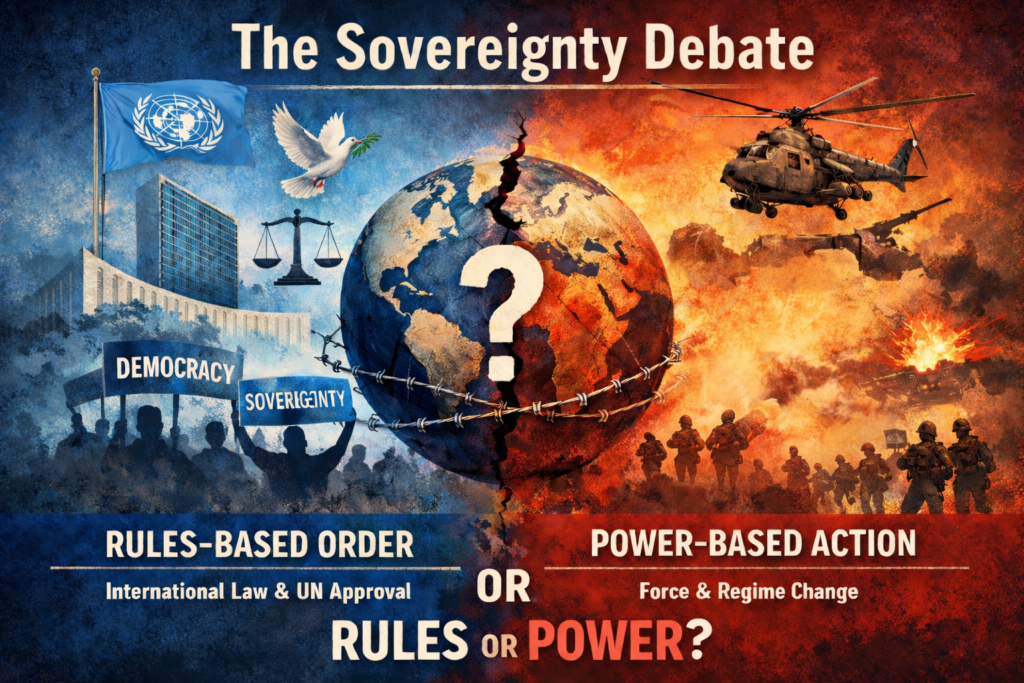
Ultimately, the dispute exposes a widening rift in global governance between two competing visions:
- A rules-based international order, where law restrains force, and
- A power-based foreign policy, where states act first and justify later
This clash raises difficult questions about whether the post–World War II system of restraint can survive in an era of ambition, rivalry, and shifting power.
Could This Be a Turning Point?
Many analysts believe that the U.S. intervention in Venezuela could mark a significant shift in global politics, not only because of what happened, but because of what it might encourage other nations to do.
1. Erosion of the U.N. System
The United Nations was created to manage international peace and prevent powerful countries from acting unilaterally.
But if major states increasingly choose to bypass the Security Council and take action on their own terms, the body may lose both authority and relevance.
If the world’s most powerful nation ignores the U.N.’s rules, smaller states may conclude those rules no longer matter — weakening the central pillar of the post-war global order.
2. Dangerous New Precedents
Once one powerful state uses military force without legal approval, others may feel entitled to follow suit.
Analysts warn that U.S. intervention could be used as justification by other nations facing territorial or political disputes:
- China could claim the same logic for acting in Taiwan
- Russia may apply it in former Soviet republics
- Turkey, Iran, or other regional powers could intervene in neighboring states during crises
Even if situations differ, the message may be interpreted as simple: if the U.S. can do it, why can’t we?
3. Rising Instability
International peace depends on predictable rules. When those rules are ignored — or appear optional — mistrust spreads quickly.
States may build up their militaries, strengthen alliances, or take pre-emptive action out of fear.
Instead of restoring order, unilateral interventions often produce more uncertainty, escalating tensions rather than resolving them.
Human and Regional Impact
While legal debates and diplomatic reactions dominate headlines, the most immediate consequences will be felt by ordinary Venezuelans. The intervention has introduced new uncertainty into a country already strained by years of economic hardship and political turmoil.
Many analysts warn of several potential ripple effects:
- Rising displacement and refugee flows, as families flee instability and the risk of internal violence. For millions already living with food shortages, power cuts, and limited healthcare, even small shocks can trigger mass migration.
- Political fragmentation and power struggles, as competing factions — civilian, military, and regional — jockey to fill the sudden leadership void. The removal of a head of state does not automatically create order; in many cases, it opens the door to chaos.
- Further economic deterioration, made worse by continued U.S. and international sanctions, disrupted trade, and uncertainty about who controls the state. Investors are likely to withdraw, deepening unemployment and inflation.
- Heightened pressure on neighboring countries, particularly Colombia, Brazil, and Caribbean states, which may face new refugee arrivals and greater demands on border forces, infrastructure, and humanitarian services.
History shows that military intervention seldom guarantees stability, even when the initial military objective succeeds. Removing a government is far easier than rebuilding a fractured society — and Venezuela now confronts a deeply uncertain future.
Looking Ahead
The U.S. military intervention in Venezuela is likely to shape global perceptions of American power and responsibility well into the future. To some governments and observers, the operation appears to be a bold stand against authoritarianism — an example of a superpower acting where diplomacy failed.
However, many others interpret the move very differently: as a reckless rejection of the international rules and institutions designed to restrain unilateral force and protect smaller nations from coercion.
What happens next will determine whether this moment becomes a brief controversy or a true historical turning point. Several factors will be crucial moving forward:
- How the United States defends and explains its actions, particularly whether it presents convincing evidence that Venezuela posed a real and urgent threat
- Whether Venezuela and its neighbors can navigate the political vacuum left after Maduro’s removal, avoiding internal conflict and managing the humanitarian consequences
- If international bodies — including the United Nations, regional organizations, or global courts — launch inquiries or legal reviews, potentially challenging the legitimacy of Washington’s actions
Though opinions differ sharply, one shared reality has emerged: this intervention has forced governments, scholars, and citizens to grapple with an uncomfortable question about the future of global order.
Are we still living in a world governed by law, where even the most powerful states are bound by shared rules —
or are we entering an era where military capability and national interest overshadow treaties, institutions, and legal constraints?
Conclusion
The U.S. intervention in Venezuela represents more than a dramatic foreign policy decision — it is a direct challenge to the framework that governs international behavior. By acting without collective approval, Washington has raised doubts about whether the rules designed to limit war are still respected. If such unilateral action becomes normalized, smaller nations could find themselves increasingly vulnerable, and global stability may weaken.
Regardless of whether one believes the strike was morally justified or dangerously misguided, it marks a pivotal moment in the ongoing struggle between national power and international law — a debate that will shape global politics for years ahead.