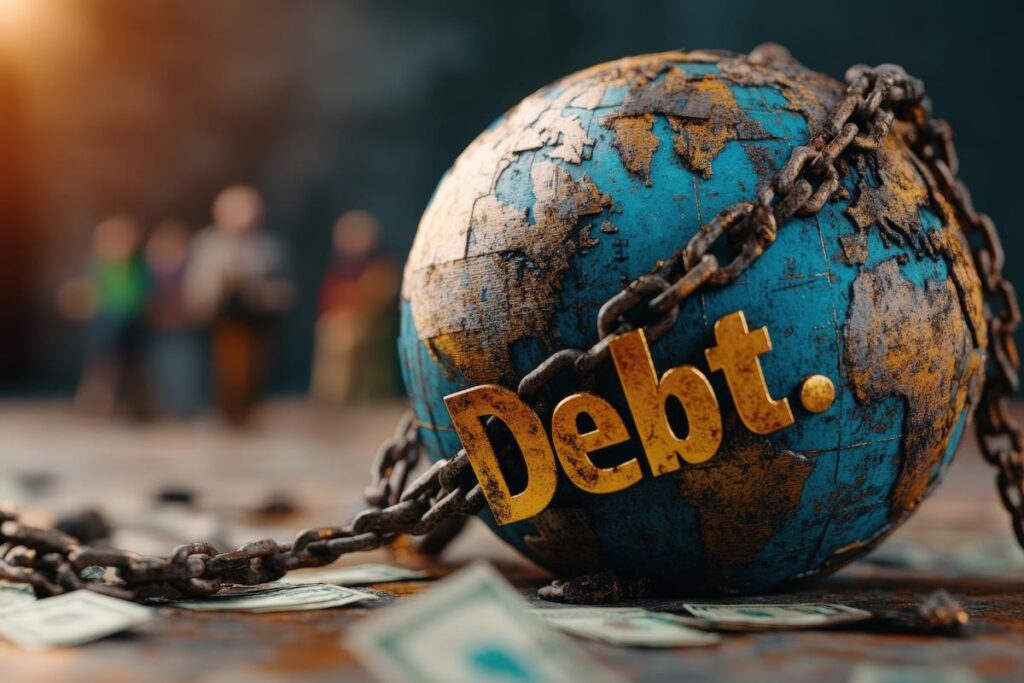
In recent years, the world has been witnessing a crisis that is silently growing yet affecting every nation on Earth — the global debt crisis. From the United States to Japan, from India to African and European nations, almost every country today is struggling with record-breaking levels of debt. Governments are taking huge loans to manage their economies, but the repayments are becoming harder every year. The result? Nations are drowning in loans, and the weight of this debt is shaping the world economy.
This article explains why global debt is rising, how it is affecting different countries, what dangers it brings for the future, and what solutions experts believe can fix this problem.
What Is Global Debt?
Global debt refers to the total amount of borrowing by:
- Governments
- Corporations
- Households
To run the country, build infrastructure, provide welfare, and fight crises like pandemics, governments borrow money from international banks, organizations, and bond markets. Borrowing itself is not bad — but when countries borrow more than they can repay, a debt crisis begins.
How Big Is the Global Debt in 2025?
The global debt in 2025 has crossed $320 trillion, making it the highest debt level ever recorded in human history. This amount includes the combined borrowing of governments, corporations, and households worldwide. To put this into perspective, the entire global economy — also known as world GDP — is Approx $110 trillion, which means the world owes three times more money than it produces annually.
This imbalance reveals that the modern financial system is being driven more by borrowed money than real earnings, and it becomes increasingly difficult to return to a stable position once debt rises to this scale.
Debt Growth Over Time
The rise of global debt did not happen overnight. It has been increasing steadily over the past 25 years:
| Year | Total Global Debt |
|---|---|
| 2000 | $84 trillion |
| 2010 | $140 trillion |
| 2020 | $257 trillion |
| 2025 | $320+ trillion |
In just 25 years, global debt has:
- Nearly quadrupled
- Risen far faster than population growth
- Risen faster than global income or productivity
This means countries are borrowing much more money without generating a proportional increase in economic output.
Why Did Debt Increase So Rapidly in 25 Years?
Global debt is rising at an alarming pace, and governments across the world are taking larger loans than ever before. But why is this happening? The reasons are complex and interconnected. Below are the major factors that are driving nations toward higher and higher borrowing:
1. Pandemic & Economic Slowdowns
The COVID-19 pandemic shook the global economy and forced almost every government to spend far beyond their budgets. To protect citizens and keep economies alive, countries had to borrow heavily to finance:
- Free vaccination programs
- Healthcare facilities and emergency hospitals
- Financial aid for struggling businesses
- Unemployment benefits and welfare schemes
Although the pandemic is largely over, many countries are still recovering from the financial damage. Revenue levels remain weak, job markets haven’t fully stabilized, and economic growth is slower than expected—forcing governments to continue borrowing even after COVID-19.
2. Wars and Geopolitical Conflicts
Modern conflicts have not only caused human suffering but have also reshaped global economics. Wars such as the Russia-Ukraine conflict and ongoing tensions in the Middle East have:
- Increased military and defense budgets
- Disrupted global supply chains
- Reduced energy and food availability
- Caused price hikes in fuel, gas, and essential goods
To tackle these challenges and stabilize their economies, many nations are borrowing extra funds, further increasing global debt.
3. Pressure of Development and Infrastructure
To remain competitive and support population growth, countries are investing in large-scale development projects. These include:
- Highways, metro lines, and high-speed railways
- Airports and ports
- Smart cities and housing projects
- Digital connectivity and cybersecurity infrastructure
While such investments help long-term economic growth, they require massive capital. Since tax revenue is not enough to fund these projects, governments rely on loans—raising their debt burden.
4. Inflation and Rising Interest Rates
High inflation has become a global issue. When prices of essential goods rise, governments increase spending on subsidies, social security, and welfare programs to support citizens. At the same time:
- Central banks are increasing interest rates to control inflation
- The cost of borrowing becomes higher
- Existing loans become more expensive to repay
This creates a financial trap—nations borrow more while also paying more interest, pushing debt to record levels.
5. Decline in Exports and Slowing Global Trade
Many countries are importing more than they export, leading to trade deficits. When nations earn less from foreign trade than they spend, they must borrow to fill the gap. The situation has worsened due to:
- Supply chain disruptions
- Rising shipping and fuel costs
- Slow demand from global markets
- Competition from cheaper exporters
As exports fall and revenue shrinks, governments turn to domestic and international loans to fund their budgets.
Why the $320 Trillion Debt Number Is Extremely Concerning
The number becomes worrying when compared to the world’s income:
Global Debt ($320T) > Global GDP ($110T)
Meaning → The world owes Approx 3x more money than it earns in a year.
If the current borrowing trend continues:
- Global debt could cross $350 trillion by 2027
- By 2030, it may surpass $400 trillion
The fear is that many countries, especially developing or struggling nations, may not be able to repay their loans, leading to:
- Loan defaults
- Currency crashes
- Unemployment spikes
- Collapse of banking systems
- A global recession
How the Debt Situation Differs for Rich & Poor Nations
Debt affects every country, but the impact is very different for rich and poor nations. Wealthy economies such as the USA, Japan, and major EU countries have very high borrowing capacity and medium repayment risk. They can borrow large amounts because global investors trust their economies, and they issue debt in their own currencies. These governments also have strong central banks that can control interest rates, print money if necessary, and stabilize financial markets during crises. As a result, even if their debt levels are high, they rarely face sudden repayment pressure.
Developing countries like India, Brazil, and Indonesia have moderate borrowing capacity but high repayment risk. They can raise funds, but their currencies and financial markets are not as strong as those of rich nations. When global interest rates rise or their currencies weaken, their debt becomes harder to manage.
The most vulnerable are struggling nations such as Sri Lanka, Pakistan, and Argentina. Their borrowing capacity is low but repayment risk is very high. Since they mostly borrow in foreign currencies like the US dollar, any currency depreciation sharply increases their debt burden. This can lead to default, IMF bailouts, austerity measures, and deep economic pain for citizens.
The Biggest Hidden Issue — Interest
When debt crosses a certain level, a country ends up borrowing not for development, but to repay old interest.
Example:
- Government borrows money in January
- By July, it must borrow more just to pay the interest on the previous loan
- Later, it borrows again to pay interest on interest
This cycle is called a debt trap, and many countries are already inside it.
Conclusion
The global debt crisis is not just a financial problem — it is shaping the future of the world. Countries are drowning in loans due to wars, pandemics, inflation, development costs, and slowing trade. If the debt spiral continues, the world may face a major economic breakdown affecting millions of lives.
To prevent this, nations must focus on sustainable economic growth, responsible borrowing, export-driven development, and reduced dependency on foreign loans. The world is at a critical financial crossroads, and the decisions made today will determine the future stability of the global economy.