Introduction
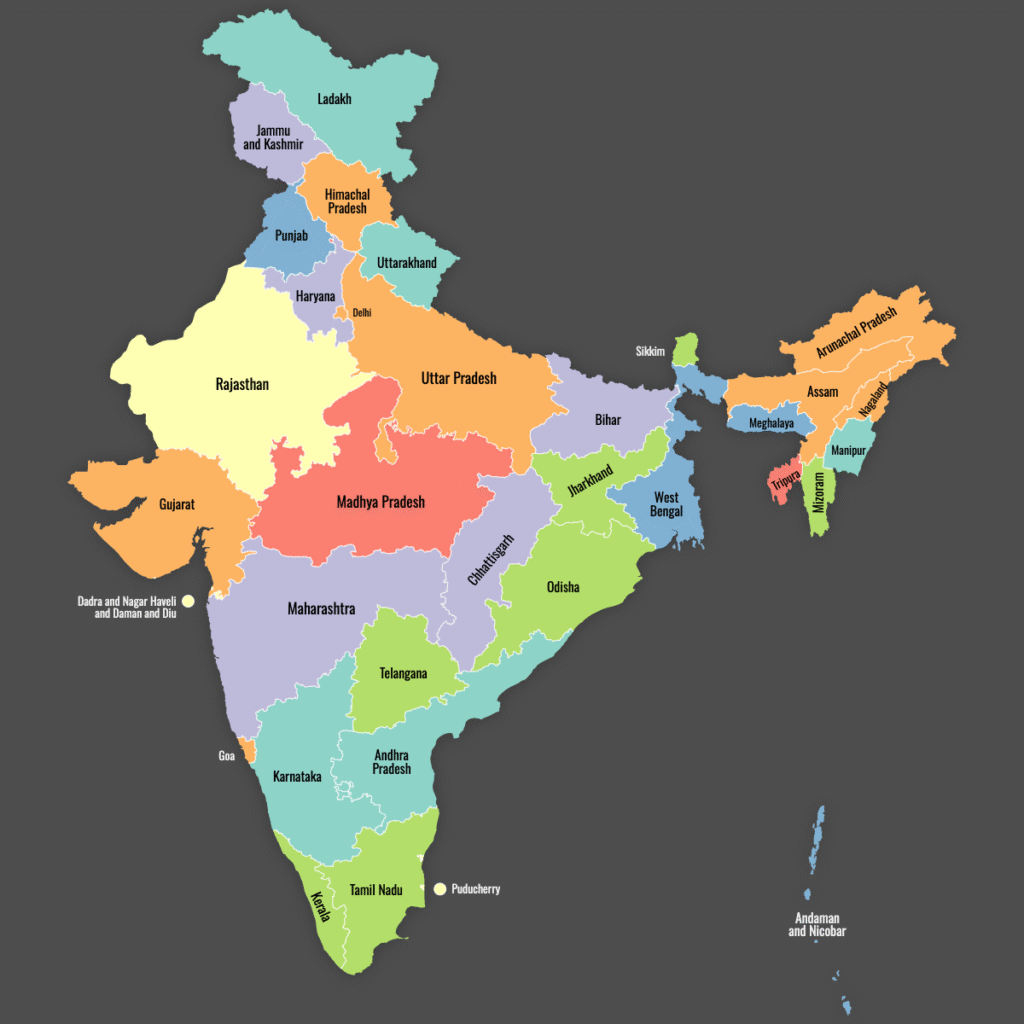
India is a federal country, which means power is divided between the central government and state governments. Today, India has 28 States and 8 Union Territories.
After India got independence from British rule on 15 August 1947, the country went through many changes to make administration easier and to respect different languages, cultures, and regions. These changes led to the creation and reorganisation of states and union territories over the years.
Formation of Indian States
Early Years (1947–1956)
After independence, India had several provinces and princely states. Many small princely states were merged into larger administrative units. However, these states were not based on language or culture, which caused demands for linguistic reorganisation.
- In 1953, the first linguistic state, Andhra State, was created from the Telugu-speaking areas of Madras State.
- This event led to a nationwide demand for creating states based on language.
States Reorganisation Act, 1956
This was a major turning point.
On 1 November 1956, the States Reorganisation Act was passed, which reorganised the boundaries of Indian states based mainly on linguistic lines.
As a result:
- Four types of states (A, B, C, D) were removed.
- India was reorganised into 14 States and 6 Union Territories.
- Many of today’s states such as Kerala, Karnataka, Madhya Pradesh, Punjab, and Andhra Pradesh took shape on this date.
This is why many states celebrate 1 November as their State Formation Day.
After 1956, several new states were created and renamed over time. Here’s a timeline of important changes:
| Year | State / Change | Details |
|---|---|---|
| 1960 | Gujarat and Maharashtra | Bombay State was divided into two linguistic states: Gujarat (Gujarati-speaking) and Maharashtra (Marathi-speaking). |
| 1963 | Nagaland | Became the 16th state of India. |
| 1966 | Haryana and Himachal Pradesh | Haryana carved out of Punjab; Himachal Pradesh made a union territory (later a state in 1971). |
| 1972 | Manipur, Meghalaya, and Tripura | These northeastern regions got statehood. |
| 1975 | Sikkim | Became the 22nd state of India after joining the Union. |
| 1987 | Goa, Arunachal Pradesh, Mizoram | These three regions achieved statehood. |
| 2000 | Chhattisgarh, Jharkhand, Uttarakhand | Formed by dividing Madhya Pradesh, Bihar, and Uttar Pradesh. |
| 2014 | Telangana | Formed by separating from Andhra Pradesh. |
Formation of Union Territories
Union Territories (UTs) are smaller regions that are directly governed by the Central Government. Some UTs later became full states (for example, Himachal Pradesh, Goa, and Mizoram).
Here’s a list of India’s 8 Union Territories and their background:
| Union Territory | Formation / History |
|---|---|
| Andaman and Nicobar Islands | Became a UT in 1956; earlier under British administration. |
| Chandigarh | Formed in 1966 to serve as the joint capital of Punjab and Haryana. |
| Delhi (National Capital Territory) | Became a UT in 1956; later given special status as NCT in 1991. |
| Lakshadweep | Became a UT in 1956 after separation from Madras State. |
| Puducherry | Formed in 1963 after the French colonies joined India. |
| Dadra and Nagar Haveli and Daman and Diu | Merged into a single UT in 2020. |
| Jammu and Kashmir | Became a UT in 2019 after reorganisation of the state. |
| Ladakh | Also created in 2019 after being separated from Jammu & Kashmir. |
Importance of State and UT Formation
The formation of states and UTs helped India to:
- Manage different languages and cultures fairly.
- Improve governance and administration in large regions.
- Promote regional development and reduce inequality.
- Protect local identity and heritage.
- Strengthen unity in diversity, which is the core idea of India.
The story of how India’s states and union territories were formed shows the country’s growth and flexibility. From 1947 till today, India has reorganised its boundaries to ensure better administration and respect for cultural diversity. Every state and union territory has its own formation day, reminding citizens of their unique history and their role in India’s unity.