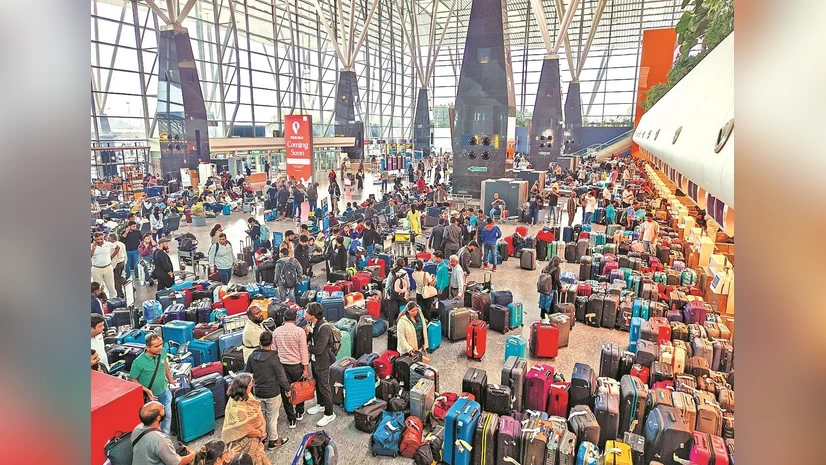
December 2025 has turned into a turbulent month for India’s aviation industry. What should have been a peak holiday and wedding travel season instead became a week of chaos, panic, and frustration for thousands of passengers, as IndiGo — India’s largest airline — cancelled more than 2,100 flights within days. On December 6 alone, nearly 400 flights were cancelled, leaving airports flooded with confused and stranded travellers.
Even though IndiGo claims that 95% of its flight operations have been restored, the situation is far from completely normal. Many passengers continue to face last-minute cancellations, long delays, missed connections, schedule changes, and high last-minute fares on alternative airlines. This is one of the worst operational disruptions in IndiGo’s history, raising serious questions about planning, staffing, and crisis management.
This report provides a comprehensive breakdown of what caused the crisis, who is most impacted, how the government and regulators have intervened, and what the aviation sector must learn from this event.
How the Crisis Started — A Timeline of the Disruptions
IndiGo’s operations began to deteriorate sharply during the first week of December 2025:
| Date | Events |
|---|---|
| Early December | First major wave of cancellations reported nationwide |
| Dec 6 | Nearly 400 flights cancelled in 24 hours — peak disruption |
| Dec 7 | Over 100 aircraft grounded at major airports, long passenger queues reported |
| Dec 7 evening | IndiGo claims 95% network restored, though delays continue |
| Expected | Full recovery between Dec 10–15, according to airline |
The timing of the crisis — right in the middle of the holiday rush, winter vacations, and wedding season — multiplied the disruption’s intensity.
Why IndiGo Cancelled So Many Flights — The Real Root Cause
The disruption is linked to new pilot fatigue management and rest regulations introduced by DGCA (Directorate General of Civil Aviation). These rules, which came into effect recently, are designed to improve air safety by reducing fatigue among pilots. Key components include:
- Longer compulsory rest periods between flights
- Limit on the number of night landings per pilot per week
- Cap on flying duty hours
- Personal leave cannot replace mandatory rest time
Although the rules were announced in advance, IndiGo reportedly did not sufficiently prepare crew schedules ahead of rollout. As soon as the regulations became applicable, the airline faced:
- Sudden shortage of available pilots
- Severe pressure on night-time operations
- Insufficient buffer staff to handle peak demand
As a result, the airline’s carefully planned December schedule — already packed due to high travel demand — collapsed rapidly.
Other factors that worsened the impact
- High passenger load due to the holiday season
- Winter weather disruptions and fog
- Congested airport slots
- Technical delays in some aircraft
The crisis therefore wasn’t triggered by one single reason — it was a perfect storm created by regulatory changes + staffing shortages + peak travel load.
Major Consequences of the IndiGo Crisis
Impact on Passengers
The biggest burden has fallen on travellers. Across the country, many passengers experienced:
- Hours or even days waiting at airports
- Missed weddings, business events, vacations, and international connections
- Stress of cancelling hotel bookings and trip plans
- Sleepless nights in terminals due to uncertainty
- In some cases, extra costs much higher than the original ticket price
Because of extreme demand, booking alternatives became difficult:
- Prices with other airlines jumped
- Many trains were full
- Last-minute tickets for long-distance travel became unaffordable for some
This situation has damaged the trust many regular flyers had in IndiGo, a brand previously known for dependability and punctuality.
Impact on IndiGo and Shareholders
While passengers suffered immediate disruption, the airline is facing long-term consequences:
- Reputational damage: public trust in the brand took a major hit
- On-time performance collapsed: OTP dropped sharply during the crisis
- Financial pressure: costs increased due to refunds, rescheduling, accommodation, meals, and support services
- Shareholder concerns: the crisis has put the airline’s management under scrutiny
Even after operations stabilize, the financial recovery may take weeks or months, depending on:
- Refund volume
- Loss of bookings during peak travel season
- Possible penalties or regulatory actions
Impact on the Aviation Industry & Transport Ecosystem
The ripple effects of IndiGo’s cancellations spread beyond airports:
- Other airlines saw a sudden surge in bookings
- Indian Railways deployed special trains to support stranded travellers
- Hotel and travel agents received a spike in urgent rebooking requests
The situation highlighted how dependent India’s domestic travel ecosystem is on IndiGo, since it holds the highest market share.
Government & Regulatory Action — What Has Been Done So Far
Authorities intervened quickly to reduce the burden on the public. Key steps include:
Mandatory refund clearance
The Ministry of Civil Aviation ordered IndiGo to complete all refunds for cancelled flights by Dec 7 evening — reducing financial stress on passengers.
Airfare caps to prevent price gouging
To stop airlines from charging excessive fares during passenger shortage, temporary fare ceilings were introduced:
- Up to 500 km → ₹7,500
- 500–1,000 km → ₹12,000
- 1,000–1,500 km → ₹15,000
- Above 1,500 km → ₹18,000
Show-cause notice to IndiGo CEO
DGCA issued a 24-hour show-cause notice to IndiGo CEO seeking explanation for:
- Large-scale cancellations
- Inadequate planning
- Failure to anticipate regulatory impact
Monitoring and oversight
Committees have been appointed to observe:
- Airline crisis response measures
- Passenger service support
- Refund processing and fare regulation
Airline commitment to improvement
IndiGo announced:
- Formation of a Crisis Management Group
- Enhanced support for refunds and rescheduling
- Additional customer communication channels
- Expected full restoration of flights by Dec 10–15
Conclusion
The IndiGo cancellations crisis has exposed the fragile balance between safety regulations, operational planning, and consumer convenience in India’s rapidly growing aviation market. While the new pilot fatigue management rules were introduced with the right intention — prioritising safety — the airline’s lack of preparedness, combined with peak seasonal demand, created a cascading breakdown of schedules. The result was a week of chaos that deeply affected passengers, strained infrastructure, and damaged the reputation of India’s biggest airline.
Yet this disruption also serves as a wake-up call for the entire aviation sector. Safety cannot be compromised, but neither can planning for regulatory changes be taken lightly. Airlines must invest in stronger workforce planning, better crisis response systems, and more transparent customer communication to prevent such events from repeating. For policymakers and regulators, the episode highlights the need for gradual implementation of new rules along with better industry-readiness evaluation.
Ultimately, the greatest priority must remain the passenger. Flight cancellations cannot be eliminated entirely, but they must not come as a shock without warning, support, or alternatives. As IndiGo works to restore operations and rebuild trust, and as the aviation ecosystem adapts, the lessons from December 2025 should drive long-term improvements — ensuring that India’s air travel is not only safe, but also reliable, resilient, and passenger-centric.