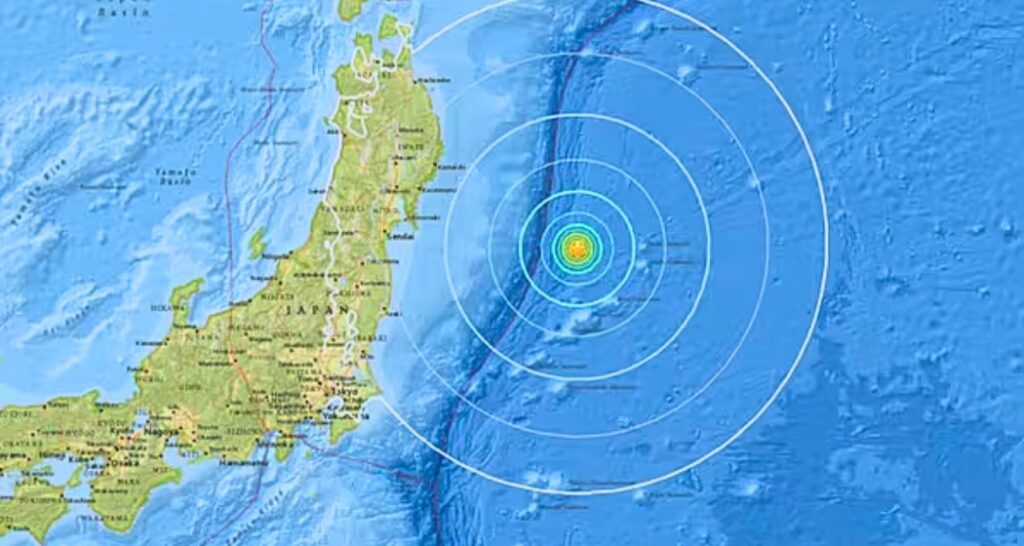
Japan issued a tsunami advisory for the Iwate Prefecture on Sunday evening after a strong offshore earthquake struck the northern Pacific region. According to the Japan Meteorological Agency (JMA), the earthquake, measured at magnitude 6.8 by the U.S. Geological Survey (USGS), occurred at approximately 5:03 p.m. local time in waters off Iwate. The agency warned that tsunami waves up to one metre (three feet) high could reach the coast at any moment.
The National Center for Seismology (NCS) in India also reported the quake, placing its magnitude at 6.6 and recording a depth of 30 kilometres. The epicentre was located at 39.51° N latitude and 143.38° E longitude in the North Pacific Ocean. These varying reports are common as different seismological agencies use distinct measuring instruments and data models to calculate earthquake magnitudes.
Following the tremor, national broadcaster NHK reported that offshore tsunami waves had been observed, prompting authorities to urge residents and fishermen to stay away from coastal and river areas. Despite these warnings, live television footage showed relatively calm seas along the Iwate coastline, suggesting that any waves reaching the shore were likely to be small and non-destructive.
Japan is no stranger to such natural events, as the country lies at the junction of four major tectonic plates — the Pacific, Philippine Sea, Eurasian, and North American plates. This region, part of the Pacific “Ring of Fire”, is one of the most seismically active zones on Earth. Japan experiences around 1,500 earthquakes every year, most of which are minor, but occasionally, major quakes cause significant damage depending on their depth and location.
The latest quake has reignited memories of the devastating 2011 Great East Japan Earthquake, a magnitude 9.0 undersea tremor that triggered a massive tsunami and caused catastrophic destruction along the northeastern coast. That disaster claimed the lives of approximately 18,500 people, either dead or missing.
While Sunday’s earthquake was far less powerful, authorities continue to monitor the situation closely, emphasizing that even smaller tsunamis can pose a threat to life and property in coastal regions. Residents of Iwate and nearby areas have been advised to remain cautious until the advisory is lifted.
Please also see this : The rings of Fire