In November 2025, Mexico experienced one of its most significant waves of youth-led demonstrations in recent years. What began as an emotional reaction to a high-profile political assassination quickly evolved into a nationwide movement against violence, corruption, and government inaction. The protests, driven largely by Generation Z citizens, drew inspiration from other global youth movements — including the 2025 Gen Z protests in Nepal — and centered around Mexico City’s historic National Palace.
Background: Rising Violence and Public Frustration
For years, Mexico has been grappling with severe security challenges. Homicide levels remain among the highest in the world; in 2023, the country recorded 23.3 murders per 100,000 inhabitants, with violence concentrated in major urban centers and cartel-heavy regions. This environment has fueled widespread public dissatisfaction, especially among young people who feel increasingly unsafe and disillusioned with government efforts to restore order.
Simultaneously, issues such as corruption, weak rule of law, and high-profile cases of impunity have deepened public mistrust. These structural problems formed the backdrop against which November’s protests erupted.
The Incident That Sparked the Movement
The immediate trigger for the demonstrations was the assassination of Carlos Manzo, the Mayor of Uruapan in the state of Michoacán. On 1 November 2025, Manzo was shot seven times while participating in the annual Festival de las Velas. Despite being rushed to the hospital, he was pronounced dead soon after.
Manzo had been openly critical of President Claudia Sheinbaum’s administration, particularly regarding its approach to combating organized crime. He had also introduced strict zero-tolerance policies in his municipality. His killing was seen as emblematic of the country’s deepening security crisis — a symbol of how even top officials were not safe from cartel influence and political violence.
This tragedy resonated strongly with young citizens, who regarded it not as an isolated event but as further evidence of systemic failure to protect both communities and leaders.
Who Organized the Protests?
The protests were largely organized and amplified by Generation Z activists using social media platforms to mobilize crowds. Although youth organizers emphasized that the movement was grassroots and non-partisan, it soon drew participants from a broad spectrum of society, including:
- university students
- human rights activists
- opposition supporters
- local community groups
- older citizens frustrated with rising insecurity
The visual language of the protests reflected global youth culture, including symbols inspired by anime, pirate/hacker aesthetics, and straw-hat imagery — mirroring elements seen in other Gen Z movements worldwide.
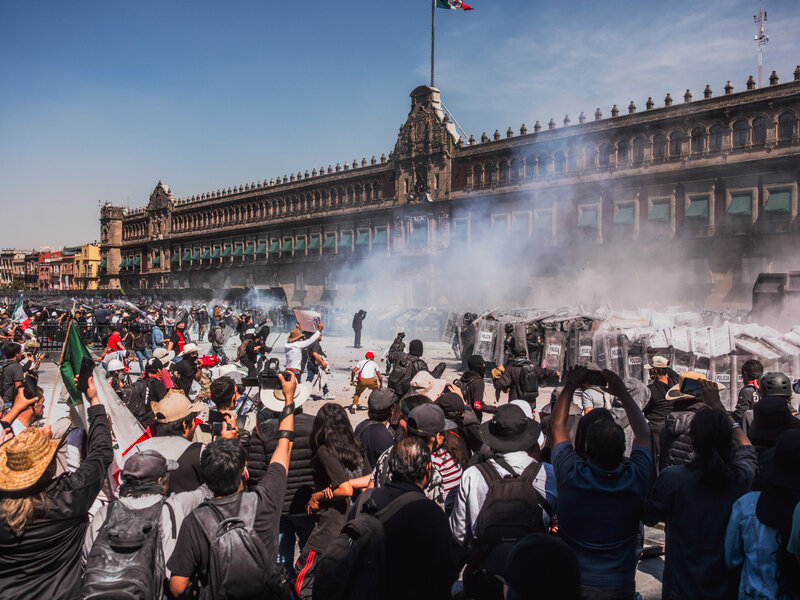
Massive crowds gathered in Mexico City’s Zócalo and in other cities nationwide. The demonstrations began with peaceful marches, candlelight vigils, and speeches condemning corruption and violence. However, tensions escalated as the protests grew larger:
- Protesters tore down metal barricades around the National Palace.
- Some groups clashed with riot police, using stones and makeshift projectiles.
- Police responded with tear gas, shields, and other crowd-control tactics.
- Authorities reported dozens to more than a hundred police officers injured.
- Several protesters were detained during confrontations.
These scenes highlighted both the anger in the streets and the government’s struggle to contain the unrest without further inflaming public sentiment.
Government Response
The administration of President Claudia Sheinbaum framed parts of the movement as “inorganic,” alleging that political opponents and social media manipulation — including the use of bots — had influenced turnout and online sentiment.
Meanwhile, protesters and independent observers argued that the demonstrations reflected genuine grassroots frustration over issues that have long plagued the country: violence, corruption, impunity, and broken judicial systems. This clash of narratives has shaped national debate and influenced how different segments of society interpret the events.
Conclusion:
The November 2025 protests underscore a powerful shift in Mexico’s political landscape. Young Mexicans — tired of violence, angered by corruption, and frustrated with governmental inaction — are stepping into the civic arena with unprecedented force.
The killing of Carlos Manzo was the spark, but the fire was fueled by years of insecurity and a growing belief that the state has failed to protect its people. As the movement evolves, its long-term impact will depend on reforms, accountability, and whether this emerging generation can sustain its push for a safer, more transparent Mexico.