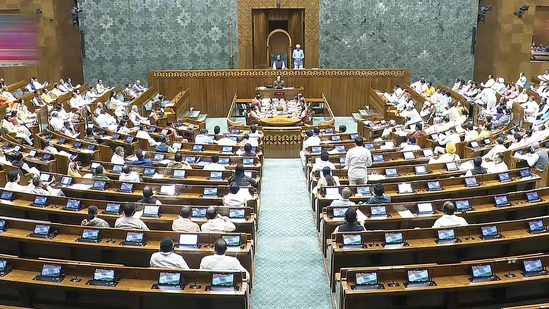
1. What is a Parliament Session?
- A session is the time period during which the Indian Parliament meets to discuss and conduct official business.
- The Parliament consists of two Houses —
- Lok Sabha (House of the People)
- Rajya Sabha (Council of States)
- A session starts from the first sitting of either House and ends when it is prorogued (formally ended) or dissolved (in the case of Lok Sabha).
- According to Article 85 of the Indian Constitution:
- The President of India summons each session of Parliament.
- The President also prorogues (ends) the session and may dissolve the Lok Sabha.
- The maximum gap between two sessions cannot be more than six months.
- This ensures that Parliament meets at least twice a year, but in practice, it meets three times annually.
2. Main Sessions of the Indian Parliament
India’s Parliament usually has three sessions every year — the Budget Session, Monsoon Session, and Winter Session.
(a) Budget Session (February – May)
- Purpose:
- To discuss and pass the Union Budget of India.
- To review the government’s income and expenditure for the upcoming financial year.
- Key Activities:
- Presentation of the Economic Survey and the Annual Budget by the Finance Minister.
- Introduction and discussion of Finance Bills and Appropriation Bills.
- General discussion on financial policies and government spending.
- Duration:
- Longest session of the year.
- Usually divided into two parts — before and after a short recess (break).
- Significance:
- It decides how the government will collect and spend money.
- It gives Parliament an opportunity to debate financial priorities and national economy.
(b) Monsoon Session (July – September)
- Purpose:
- Mainly focused on legislative business (making and amending laws).
- Discussion on government performance, policies, and national issues.
- Key Activities:
- Introduction and passing of new bills.
- Debates on social, economic, and political issues.
- Review of ministries and their performance.
- Importance:
- Usually witnesses lively debates and discussions.
- Helps hold the government accountable during mid-year.
(c) Winter Session (November – December)
- Purpose:
- To take up pending bills from previous sessions.
- To discuss current national and international matters.
- Key Activities:
- Passing of leftover bills from Budget or Monsoon Session.
- Review of government policies and year-end performance.
- Importance:
- Acts as the final review session before the year ends.
- Ensures that unfinished legislative work is completed.
(d) Special Sessions
- The President of India can summon special sessions at any time on the advice of the Council of Ministers.
- Purpose:
- For urgent national issues, emergencies, or historic events.
- Examples:
- Special sessions for constitutional amendments, emergency discussions, or commemorative occasions (like Independence anniversaries).
3. Daily Working of Parliament During a Session
Each sitting day follows a structured schedule:
- Question Hour (First Hour of the Day)
- MPs ask questions to ministers about the working of their departments.
- Purpose: To make the government accountable and transparent.
- Questions can be Starred (oral) or Unstarred (written).
- Zero Hour (Immediately After Question Hour)
- MPs raise urgent public issues without prior notice.
- It is an Indian innovation (not in the Constitution or rules).
- Government Business
- Ministers introduce and discuss bills, motions, and resolutions.
- Debate on government policies and national matters.
- Private Members’ Business
- Conducted on Fridays (usually).
- Non-minister MPs (Private Members) introduce their own bills or resolutions.
4. Important Parliamentary Tools and Devices
| Tool | Purpose | Description |
|---|---|---|
| Adjournment Motion | To discuss urgent public matters | Used to draw attention to issues of national importance. |
| No-confidence Motion | To test government’s majority | If passed, government must resign. |
| Calling Attention Motion | To raise urgent matters | MPs call attention to a specific issue needing immediate government response. |
| Short Notice Question | For urgent issues | Asked with shorter notice than regular questions. |
| Privilege Motion | Against misconduct | Raised when an MP’s privilege is violated. |
5. Constitutional Provisions Related to Bills
- Article 108 – Joint Sitting:
- If Lok Sabha and Rajya Sabha disagree on a bill, the President may call a Joint Sitting of both Houses.
- Presided over by the Speaker of Lok Sabha.
- Rarely used (only for a few bills in history).
- Article 110 – Money Bill:
- Deals only with money matters like taxation, government spending, or loans.
- Can be introduced only in Lok Sabha and only with the President’s recommendation.
- Rajya Sabha can only recommend changes — Lok Sabha may accept or reject them.
- The Speaker’s decision on whether a bill is a Money Bill is final.
6. Parliamentary Committees
- Work continues even when Parliament is not in session.
- Committees study bills, budgets, and policies in depth and present reports.
- Major committees include:
- Public Accounts Committee (PAC) – Examines government expenditure and audit reports.
- Estimates Committee – Suggests improvements in efficiency and economy of government operations.
- Departmental Standing Committees – Review bills related to specific ministries.
7. Important Terms to Remember
| Term | Meaning |
|---|---|
| Adjournment | Suspension of a sitting for a day or a specific time. |
| Prorogation | Formal end of a session by the President. |
| Dissolution | End of the life of Lok Sabha (before general elections). |
| Quorum | Minimum number of MPs required to conduct business (1/10th of total members). |
8. Importance of Parliamentary Sessions
- Ensures regular discussion and law-making.
- Keeps the government accountable to the people.
- Gives MPs a platform to raise public grievances and national issues.
- Maintains checks and balances between the Executive and the Legislature.
- Strengthens democracy by ensuring public participation through elected representatives.