The global balance of power is undergoing one of its biggest transformations since the end of the Cold War. For decades, the world was dominated by Western-led alliances like the G7, NATO, the European Union, and the Bretton Woods institutions such as the World Bank and the IMF. However, in the last few years, the international system has rapidly shifted toward a multipolar world where new power blocs are challenging Western dominance. At the center of this shift is BRICS+, an expanded version of the original BRICS group—Brazil, Russia, India, China, and South Africa.
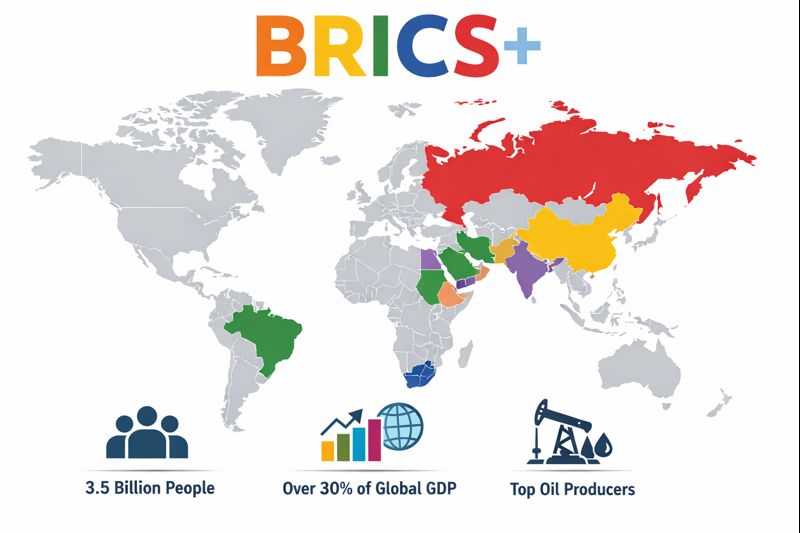
In 2024–2025, BRICS entered a historic phase of expansion by welcoming new members such as Saudi Arabia, Iran, the United Arab Emirates, Egypt, and Ethiopia. This expansion has transformed BRICS into one of the largest and most influential geopolitical and economic coalitions in the world. With its growing membership, economic strength, demographic advantage, and increasing political coordination, BRICS+ is emerging as a major counterweight to Western-dominated global institutions.
This article examines how BRICS+ is reshaping global politics in 2025, why countries are joining this new bloc, and what this means for the future of international relations.
Origins of BRICS
The idea of BRICS began in 2001 when Goldman Sachs economist Jim O’Neill predicted that Brazil, Russia, India, and China would become the world’s major emerging economies. What started as an economic forecast soon evolved into a political grouping. South Africa joined the group in 2010, changing BRIC to BRICS.
For years, BRICS served as a platform for emerging economies to discuss global financial reform, development cooperation, and reducing dependence on Western systems like the US dollar. The group emphasized values such as multipolarity, non-interference, and cooperation among the Global South.
By the mid-2020s, geopolitical tensions, trade wars, and dissatisfaction with Western dominance created the momentum for expansion. With the 2023–2024 invitations to new members, BRICS entered a new era—BRICS+.
BRICS+ Expansion: Shaping a Multipolar World and Redefining Global Power
The BRICS+ coalition, originally consisting of Brazil, Russia, India, China, and South Africa, has now expanded to include Saudi Arabia, the United Arab Emirates (UAE), Iran, Egypt, and Ethiopia. This expansion is not just symbolic—it fundamentally reshapes global geopolitics, economics, and energy dynamics. With these new members, BRICS+ now represents nearly 45% of the world’s population, about 36% of global GDP (PPP), over 40% of global oil production, and includes some of the fastest-growing economies on the planet.
Middle Eastern Strategic Influence
The inclusion of Saudi Arabia, the UAE, and Iran gives BRICS+ immense leverage over the global energy market. These nations can influence oil production, pricing, and the trajectory of future energy transitions. Their presence also signals a shift in regional diplomacy, reducing traditional Western dominance in Middle Eastern energy politics.
Africa’s Rising Representation
With South Africa and Ethiopia, BRICS+ strengthens Africa’s voice in global decision-making. Africa now has a more prominent role in shaping trade, finance, infrastructure development, and climate policies, ensuring that the continent’s concerns are no longer sidelined in international forums.
Strengthened Global South Solidarity
BRICS+ is emerging as the key platform for the Global South, advocating for financial reform, climate justice, and equitable global governance. Developing nations now have a collective voice to push back against Western dominance in institutions like the IMF, World Bank, and UN, while promoting alternatives that serve their interests.
The end of unipolar supremacy and the rise of multipolar power structures
Since the 1990s, the United States maintained a dominant position as the global superpower. However, recent trends indicate a shift toward a multipolar world:
- China has become a technological and economic powerhouse.
- India is asserting itself as a diplomatic and strategic leader.
- Russia is strengthening ties with Asia and the Middle East.
- U.S. influence is declining in Africa and the Middle East, and dissatisfaction with Western sanctions and dollar dominance is growing.
This evolving landscape creates a world where power is shared among multiple nations and blocs, rather than being concentrated in a single superpower. BRICS+ is at the heart of this transformation, bridging continents and shaping global policies in trade, energy, and governance.
Why BRICS+ Expansion is a Game-Changer
The BRICS+ expansion represents a major shift in global power dynamics:
- Economic Weight: Representing over a third of global GDP and nearly half of the population, BRICS+ can influence international trade and investment flows.
- Energy Dominance: Control over a significant portion of global oil production provides strategic leverage in global energy markets.
- Global Governance: BRICS+ pushes for reform in institutions traditionally dominated by Western powers, amplifying the voice of the Global South.
- Alternative Alliances: Countries can explore trade and financial agreements outside the Western-led framework.
- Strategic Partnerships: The coalition unites Asian, Middle Eastern, African, and Latin American powers, creating a truly global bloc capable of shaping the 21st century.
In essence, the BRICS+ expansion signals the end of unipolar dominance and the rise of a multipolar world. It empowers developing nations, strengthens global South solidarity, and positions BRICS+ as a central player in the future of international politics, economics, and energy security. The 21st century will no longer be defined by a single superpower, but by multiple nations competing, cooperating, and influencing global outcomes together.me time. BRICS+ plays a central role in shaping this change.
How BRICS+ Is Challenging Western-Dominated Institutions
The expansion of BRICS+ is not just about adding new members—it signals a strategic shift in global power. Historically, Western countries, led by the United States, have dominated international financial systems, trade, and energy markets. BRICS+ is increasingly challenging this dominance through three key approaches: alternatives to dollar dependence, reforming global financial systems, and forging new trade and energy alliances.
1. Developing an Alternative to Dollar Dominance
For decades, the U.S. dollar has been the cornerstone of global trade and finance. Many nations, especially developing economies, have relied on the dollar for imports, exports, and international reserves. BRICS+ aims to reduce this dependence through several measures:
- Trade in local currencies: Members are increasingly settling trade agreements using their own currencies instead of the U.S. dollar, keeping more control over their financial systems.
- Reduced vulnerability to sanctions: By minimizing dollar reliance, BRICS+ countries protect themselves from geopolitical pressures and financial sanctions.
- Digital currency cooperation: Some BRICS+ nations are exploring digital payment solutions that bypass traditional Western-controlled banking channels.
- Unified BRICS currency (long-term vision): While still under discussion, a common BRICS currency could facilitate seamless trade among members and reduce exposure to dollar fluctuations.
Implication: By moving away from the dollar, BRICS+ is creating a financial shield against Western influence and increasing economic sovereignty for its members.
2. Reforming Global Financial Systems
Western-dominated institutions like the IMF, World Bank, and SWIFT payment system have traditionally dictated global financial rules. BRICS+ is challenging this model by offering alternatives:
- New Development Bank (NDB): BRICS established its own development bank to provide loans for infrastructure and development projects.
- No political conditionality: Unlike Western institutions, NDB loans typically come without strict political conditions, making them more attractive to developing countries.
- Financial independence: Through the NDB and other BRICS-focused funds, member countries can pursue projects without relying on Western-dominated institutions.
Implication: BRICS+ is creating a parallel financial ecosystem that empowers developing nations, giving them more options and bargaining power on the global stage.
3. New Alliances in Trade and Energy
Trade and energy cooperation are central to BRICS+ influence. By forming new routes and partnerships, the bloc is reshaping global markets:
- Oil and energy trade: China and India are importing more oil from BRICS+ members, reducing dependence on Western suppliers.
- Renewable energy investment: Gulf nations like the UAE and Saudi Arabia are collaborating with BRICS members on clean energy projects, signaling a shift toward collective energy security.
- Trade redirection: Russia is increasingly redirecting trade from Europe toward Asia and the Middle East, bypassing traditional Western markets.
Implication: Energy and trade cooperation not only strengthens BRICS+ economically but also gives it strategic leverage over global markets.
Why Countries Are Choosing BRICS+ Over Western Alliances
Many nations are increasingly turning to BRICS+ as an alternative to traditional Western-led alliances. The bloc offers a unique combination of economic opportunities, political autonomy, and global influence, making it highly attractive for developing and emerging economies.
1. More Equal Partnerships
BRICS+ emphasizes mutual respect and non-interference in domestic affairs, offering countries partnerships based on equality rather than hierarchy. This approach contrasts with some Western alliances, where smaller nations often face pressure to align with the policies of more powerful members.
2. Alternatives to Western Pressure
For nations wary of sanctions, political conditions, or stringent requirements tied to Western loans, BRICS+ provides a safer and more flexible economic and diplomatic environment. Membership or cooperation allows countries to pursue development projects without the risk of punitive measures.
3. Access to New Markets and Investment
BRICS+ members represent fast-growing economies with vast trade and investment potential. Participation in the bloc opens doors to major infrastructure projects, technological partnerships, and expanding markets, creating opportunities that Western alliances may not prioritize.
4. Greater Representation for the Global South
Developing nations often feel underrepresented in global organizations such as the IMF, World Bank, or UN decision-making processes. BRICS+ offers a platform where these countries can have a stronger voice in shaping international economic, political, and environmental policies.
India and China: Cooperation Despite Rivalry
India and China are two of the most influential members of BRICS+, and their collaboration is crucial for the bloc’s effectiveness. Despite border disputes and geopolitical rivalry, BRICS+ offers a platform where both nations can work together toward shared goals:
- China’s economic leverage: With its vast manufacturing base, trade networks, and investment capacity, China provides significant economic strength to BRICS+.
- India’s diplomatic credibility: India brings strategic diplomacy, fostering trust and neutrality among other member countries.
- Unified stance against Western dominance: Together, India and China help BRICS+ challenge traditional Western-led global governance structures.
India’s participation is particularly noteworthy because it is often perceived as a neutral and reliable partner, enabling cooperation even among countries with historical tensions. This balance between economic power and diplomatic influence strengthens BRICS+ as a cohesive force on the global stage.
Criticisms and Challenges Facing BRICS+
While BRICS+ has rapidly expanded and increased its global influence, the bloc faces several significant challenges that could affect its cohesion and long-term effectiveness.
1. Internal Political Differences
BRICS+ members have diverse and sometimes conflicting political interests. Tensions exist between countries like Saudi Arabia and Iran, India and China, as well as geopolitical disagreements involving Russia. These differences can complicate decision-making and slow consensus on key issues.
2. Lack of a Unified Strategic Vision
Unlike structured alliances such as NATO or the European Union, BRICS+ does not have a clearly defined security or defense framework. The absence of a shared strategic roadmap makes coordinated action in critical geopolitical situations more challenging.
3. Economic Diversity
The economic disparity among members—from wealthy nations like Saudi Arabia to developing economies like Ethiopia—creates difficulties in establishing common economic policies. Diverse levels of development, infrastructure, and financial stability can limit the bloc’s ability to pursue unified goals.
4. Dependence on U.S.-Led Systems
Despite efforts to reduce reliance on the U.S. dollar and Western-dominated financial systems, global trade is still largely dollar-driven. Shifting away from these entrenched systems is complex, gradual, and challenging, requiring time and coordinated effort.
What BRICS+ Means for the Future of Global Politics
BRICS+ is not seeking to replace Western alliances; rather, it aims to foster a more balanced and multipolar global order. By providing an alternative platform for cooperation, it empowers developing nations and emerging economies to have a stronger voice in international affairs.
Key Developments to Expect in the Next Decade
- Further Expansion: Interest from countries such as Argentina, Indonesia, and Türkiye indicates that BRICS+ may grow even larger, increasing its global influence.
- Trade in Local Currencies: Members are likely to continue reducing dependence on the U.S. dollar, promoting trade and financial transactions in their own currencies.
- Strengthening the New Development Bank (NDB): The NDB will play an increasingly central role in financing infrastructure, development, and green energy projects, providing an alternative to traditional Western-led financial institutions.
- Leadership in Global Policy Areas: BRICS+ is positioning itself to take the lead in climate action, energy transitions, and digital governance, shaping the rules for the 21st century.
- Challenging Western Dominance: By promoting financial and political alternatives, BRICS+ gradually reduces the influence of Western-dominated systems.
Implication: The future global system is likely to resemble a network of multiple power centers, rather than a rigid hierarchy dominated by a single superpower. BRICS+ is at the forefront of this shift, promoting collaboration, equitable representation, and shared influence across continents.
Conclusion
As of 2025, BRICS+ has emerged as one of the most influential and fastest-growing global blocs. With its expanded membership, growing economic clout, significant control over energy markets, and coordinated political strategy, BRICS+ is actively reshaping the global order. This evolution signals the decline of unipolarity and the rise of a multipolar world, where power is distributed among several influential blocs rather than concentrated in a single superpower.
For the first time in decades, nations of the Global South have a platform that genuinely represents their interests on the global stage. BRICS+ is more than an economic coalition—it is a geopolitical force poised to influence global diplomacy, trade, and international relations for years to come.
If these trends continue, the coming decade could be remembered as the era when the world truly became multipolar, with BRICS+ at the center of this historic transformation.