Introduction
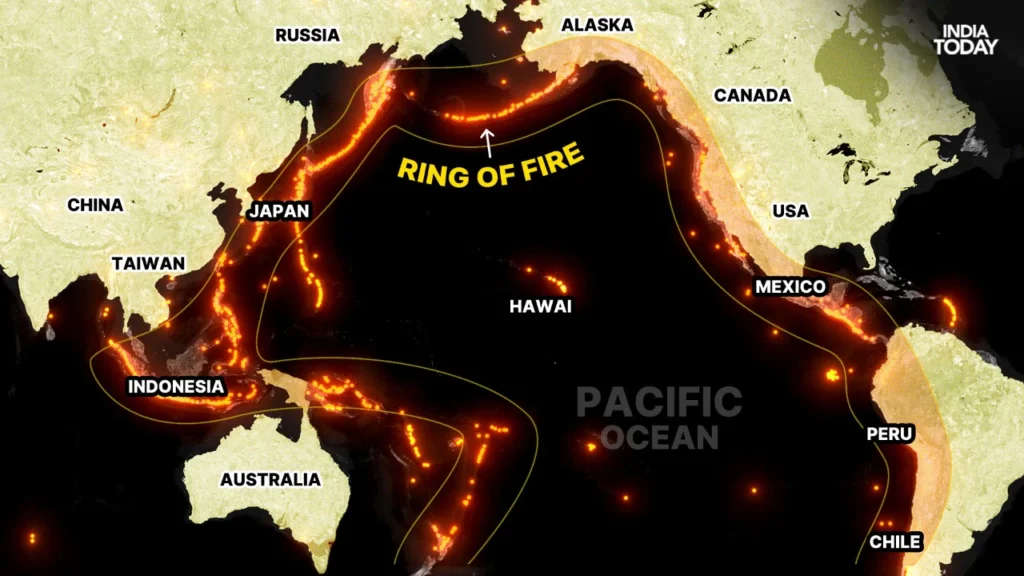
The Ring of Fire, also known as the Pacific Ring of Fire, Rim of Fire, or Circum-Pacific Belt, is the most geologically active region on Earth. It forms a horseshoe-shaped zone around the edges of the Pacific Ocean, stretching for about 40,000 kilometers (25,000 miles) and up to 500 kilometers (310 miles) wide. This vast region is famous for its frequent earthquakes, volcanic eruptions, and deep ocean trenches.
The Ring of Fire is home to nearly two-thirds of the world’s volcanoes (around 750–915 active or dormant) and generates about 90% of the world’s earthquakes, including the most powerful ones in recorded history.
Geological Structure and Formation
The Ring of Fire is not a single structure, but a complex chain of subduction zones, trenches, volcanic arcs, and mountain ranges. It is created by the movement of tectonic plates, which make up the Earth’s outer shell (lithosphere). These plates constantly move, collide, and slide past one another.
Key interactions include:
- The Nazca, Cocos, and Antarctic Plates moving beneath the South American Plate
- The Pacific and Juan de Fuca Plates subducting under the North American Plate
- The Philippine Plate subducting under the Eurasian Plate
- Collisions between the Pacific and Australian Plates
These interactions have produced some of the world’s most significant geological features, such as the Andes Mountains, Japanese Archipelago, Aleutian Islands, and the Cascade Range in North America.
Why So Many Earthquakes Occur Here
Earthquakes in the Ring of Fire occur because tectonic plates move and interact. Most boundaries around the Pacific are convergent (subduction) or transform boundaries:
- Subduction zones: One plate (usually oceanic) sinks beneath another. This process causes immense stress to build up until it suddenly releases, producing massive earthquakes and sometimes tsunamis.
- Transform faults: Plates slide past each other horizontally, causing shallow but powerful earthquakes, such as those along California’s San Andreas Fault.
- Complex collisions: In some regions, plates push, twist, or crush each other, creating a web of faults and fractures that generate frequent smaller quakes.
Types of Earthquakes in the Ring of Fire
- Megathrust Earthquakes:
The largest and most destructive type, occurring at subduction zones (magnitude 9 or higher). These can trigger huge tsunamis.- Example: 1960 Chile (Mw 9.5), 2004 Sumatra–Andaman (Mw 9.3), 2011 Tōhoku, Japan (Mw 9.1)
- Intraslab Earthquakes:
Occur deep within a subducting plate as it bends and sinks into the mantle. - Shallow Crustal Earthquakes:
Take place near the surface along faults in the overriding plate and can cause heavy local damage.
Volcanic Activity
The Ring of Fire includes over 350 historically active volcanoes, most of which are stratovolcanoes — tall, steep-sided cones built from layers of lava and ash.
Examples: Mount St. Helens (USA), Mount Fuji (Japan), and Mount Mayon (Philippines).
The lava is usually andesitic or basaltic andesite, which produces explosive eruptions. The Ring of Fire has generated the four largest volcanic eruptions of the Holocene epoch and continues to reshape Earth’s surface through both land-based (subaerial) and underwater (submarine) volcanoes.
Major Regions of the Ring of Fire
The Ring of Fire surrounds the Pacific and touches parts of Asia, Oceania, North and South America, and Antarctica:
- South America: Andes Mountains and Chilean volcanic zones
- Central America and Mexico: Volcanic arcs along the Caribbean boundary
- North America: Cascade Range, Alaska’s Aleutian Islands
- Asia: Japan, Philippines, Kuril and Kamchatka arcs
- Oceania: Indonesia, Papua New Guinea, Tonga, and New Zealand
These regions are prone to both volcanic eruptions and large earthquakes, making them some of the most hazardous places on Earth.
Subduction Zones and Deep Trenches
The Ring of Fire includes the world’s deepest ocean trenches formed by subducting plates:
- Peru–Chile Trench
- Mariana Trench (deepest point on Earth)
- Japan and Kuril–Kamchatka Trenches
- Tonga and Kermadec Trenches
Older oceanic crust subducts at steeper angles (like the Mariana Trench), while younger crust creates shallower zones (like near South America).
Gaps and Variations
The Ring of Fire is not completely continuous. Some areas—like parts of California, northern Mexico, and British Columbia—lack subduction volcanoes. Instead, they feature transform faults or continental rifting, which still produce strong seismic activity.
Conclusion
The Ring of Fire is the most geologically active region on Earth. Its volcanoes, earthquakes, and ocean trenches reveal the immense power of plate tectonics shaping our planet. While it poses significant hazards to millions living along its edges, ongoing research and technology have improved our ability to predict, prepare for, and respond to these natural forces — reminding us that Earth’s crust is ever-changing and alive beneath our feet
Pingback: Japan Issues Tsunami Advisory After Strong Offshore Earthquake in Iwate Prefecture – Learning Post