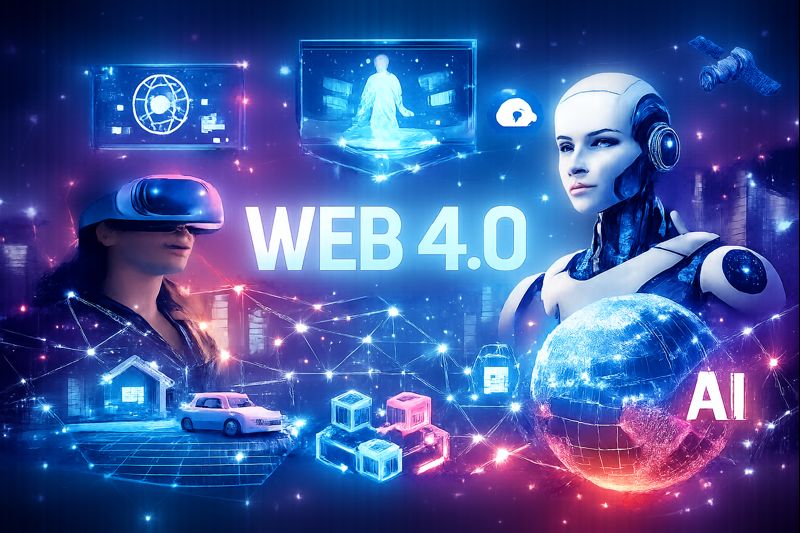
Over the last three decades, the internet has evolved in remarkable ways. From static web pages to social media, mobile apps, and AI-powered platforms, each phase of the web has reshaped how humans communicate, work, and live. Today, we stand at the edge of a new transformation—Web 4.0, often described as the intelligent, autonomous, and human-centric web.
While Web 3.0 focuses on decentralization and blockchain, Web 4.0 goes a step further by combining artificial intelligence, automation, IoT, big data, and real-time personalization to create a truly symbiotic relationship between humans and machines.
In this article, we will explore what Web 4.0 is, how it differs from previous web generations, and how it will change the internet forever.
Understanding the Evolution of the Web
To truly understand Web 4.0, we must first explore how the internet has evolved over time. Each phase of the web reflects a major shift in how humans interact with information, technology, and each other.
Web 1.0 – The Read-Only Web (Information Era)
Web 1.0 marked the birth of the internet in the 1990s. It was simple, static, and one-directional.
Key Characteristics:
- Static HTML web pages
- Minimal design and no personalization
- No interaction between users and websites
- Information flowed only from website owners to readers
At this stage, the internet functioned like a digital newspaper. Users could read content, but they could not comment, share, or participate. Despite its limitations, Web 1.0 laid the foundation for global connectivity.
Web 2.0 – The Social Web (Participation Era)
Web 2.0 transformed users from passive readers into active participants. This phase introduced interaction, collaboration, and social networking.
Key Characteristics:
- User-generated content
- Social media platforms like Facebook, YouTube, and Twitter
- Blogs, comments, likes, shares, and reviews
- Cloud computing and mobile internet
This era gave rise to the creator economy, online communities, and digital businesses. People could express opinions, build personal brands, and connect globally in real time. However, data ownership largely remained with centralized platforms, raising concerns around privacy and control.
Web 3.0 – The Decentralized & Semantic Web (Ownership Era)
Web 3.0 focuses on intelligence, decentralization, and data ownership. It aims to fix the trust and privacy issues created by Web 2.0.
Key Characteristics:
- Blockchain and decentralized networks
- User ownership of data and digital assets
- Cryptocurrencies, NFTs, and smart contracts
- Semantic web enabling smarter, context-based search
Instead of platforms owning user data, Web 3.0 empowers individuals. Search engines become more intelligent, understanding intent and meaning, not just keywords. This shift marks the transition from “platform-controlled internet” to user-controlled internet.
Web 4.0: The Intelligent, Self-Operating Web (Cognitive Era)
Web 4.0 represents the next leap—an internet that is not only smart but also adaptive, predictive, and autonomous.
Key Characteristics:
- AI-driven decision making
- Human–machine collaboration
- Context-aware and predictive systems
- Integration of AI, IoT, big data, and real-time analytics
In Web 4.0, the internet understands user behavior, emotions, and context. Systems can anticipate needs, automate decisions, and respond in real time. Examples include:
- AI assistants that act before you ask
- Smart healthcare systems predicting diseases
- Autonomous vehicles communicating with infrastructure
- Personalized digital experiences across devices
Web 4.0 is not just an upgrade—it is a fundamental shift in how the internet thinks, responds, and acts. The web evolves from a tool into an intelligent partner, working alongside humans to enhance productivity, decision-making, and daily life.
What Is Web 4.0?
Web 4.0 is the next stage of the internet where technology becomes smart, responsive, and human-centric. Instead of just showing information, the web starts to understand users—their needs, behavior, and situations—and responds automatically.
Often called the Symbiotic Web, Web 4.0 allows machines to work alongside humans. It uses advanced technologies like artificial intelligence, connected devices, and real-time data to make the internet more helpful and intuitive.
In simple terms, Web 4.0 acts like a smart assistant rather than a basic tool. It can predict what users might need, personalize experiences, and automate actions without constant input.
By combining AI, IoT, big data, cloud computing, and immersive technologies, Web 4.0 creates faster, smarter, and more personalized digital experiences that fit naturally into everyday life.
Key Features of Web 4.0
1. Hyper-Personalization
Web 4.0 focuses on creating experiences designed for individual users, not large groups. Instead of offering the same content to everyone, the web adapts in real time based on user behavior, preferences, and even emotional state. Websites may change their layout depending on how a user interacts, learning platforms can adjust lessons to match a student’s learning speed, and e-commerce platforms can suggest products before users actively search. The idea shifts from “one-size-fits-all” to “one-size-for-you.”
2. Artificial Intelligence at the Core
In Web 4.0, artificial intelligence is not an extra feature—it is the foundation of the entire system. AI enables machines to understand natural language, recognize emotions, make independent decisions, and continuously improve through learning. Search engines will move beyond simply answering questions and will begin solving problems proactively, offering solutions before users even realize they need them.
3. Autonomous Systems and Smart Agents
Web 4.0 introduces intelligent digital agents that can act independently on behalf of users. These agents can book travel by analyzing calendars and preferences, negotiate prices online, or manage financial planning and investments automatically. Instead of manually controlling every step, humans will increasingly delegate decision-making, allowing technology to handle complex tasks efficiently.
4. Internet of Things (IoT) Integration
With billions of connected devices, Web 4.0 extends the internet into the physical world. Smart homes will anticipate daily routines, healthcare devices will monitor health continuously, and smart cities will optimize traffic, energy usage, and public safety in real time. The web will no longer be limited to screens—it will be embedded into everyday environments.
5. Context-Aware Computing
Web 4.0 systems will understand context such as location, time, surroundings, emotional state, and past behavior. This allows the internet to respond intelligently rather than just follow commands. For example, a navigation app may suggest a calmer route when stress levels are high, or a work platform may reduce notifications during deep-focus periods. The web becomes aware, adaptive, and responsive to real-life situations.
How Web 4.0 Will Change the Internet
1. Predictive and Conversational Search
In Web 4.0, search will no longer depend on typing keywords. Future search systems will anticipate user needs and deliver answers even before questions are asked. By combining voice, visual cues, and emotional context, search will feel more like a natural conversation than a simple query, making information access faster and more intuitive.
2. Websites as Living Interfaces
Traditional static websites will fade away. Web 4.0 websites will adapt in real time, changing their design, content, and navigation based on user behavior and context. These websites will interact more like human assistants, ensuring that every visit feels personalized and unique.
3. Autonomous Digital Commerce
Online shopping will become smarter and more automated. AI agents will be able to shop on behalf of users, negotiate prices dynamically, and manage subscriptions based on actual usage. As a result, consumers will shift from being active buyers to decision supervisors, overseeing intelligent systems that handle purchases efficiently.
4. Adaptive and Lifelong Education
Education in the Web 4.0 era will be highly personalized and continuous. Learning platforms will automatically adjust difficulty levels, instantly identify knowledge gaps, and create custom learning paths for each learner. Education will no longer be limited by age, location, or fixed schedules, making lifelong learning the norm.
5. Preventive and Intelligent Healthcare
Web 4.0 will transform healthcare by focusing on prevention rather than treatment. Continuous health monitoring, AI-assisted diagnosis, and predictive disease detection will help identify health risks early. This shift moves healthcare from reactive care to proactive wellness management.
6. Smarter and More Efficient Work
Work environments will become more intelligent with Web 4.0. AI will handle repetitive and routine tasks, allowing humans to focus on creativity, strategy, and innovation. Smart systems will optimize productivity, while remote work, automation, and human–AI collaboration become standard ways of working.
Challenges and Risks of Web 4.0
While Web 4.0 offers many benefits, it also brings important challenges that cannot be ignored. As the internet becomes more intelligent and autonomous, careful planning and regulation will be essential to ensure a balanced and responsible future.
1. Data Privacy and Security
Web 4.0 relies heavily on data to deliver personalized experiences. However, increased data collection also raises the risk of misuse, cyberattacks, and unauthorized access. Protecting user data and ensuring strong security systems will be a major concern.
2. Ethical Use of Artificial Intelligence
As AI takes on greater decision-making power, issues such as bias, transparency, and accountability become critical. Ensuring that AI systems are fair, explainable, and ethically designed will be essential to maintain trust and prevent harm.
3. Digital Divide
Not everyone will have equal access to advanced technologies required for Web 4.0. This could widen the gap between developed and developing regions, increasing social and economic inequality if inclusivity is not prioritized.
4. Over-Automation and Loss of Human Control
Excessive reliance on AI and automation may reduce human involvement in decision-making. Maintaining a balance between automation and human judgment is necessary to ensure that technology empowers people rather than replaces them.
Addressing these challenges responsibly will determine whether Web 4.0 becomes a force for inclusive progress or a source of new risks.
Web 4.0 vs Web 3.0: Key Differences
| Feature | Web 3.0 | Web 4.0 |
|---|---|---|
| Core Focus | Decentralization and user data ownership | Intelligence, automation, and smart decision-making |
| Key Technologies | Blockchain, smart contracts, cryptocurrencies | Artificial Intelligence, IoT, Big Data, cloud and edge computing |
| User Role | User as the owner of data and digital assets | User as a human–machine partner working with intelligent systems |
| Type of Interaction | Semantic and context-aware understanding | Predictive, adaptive, and autonomous interaction |
When Will Web 4.0 Become Reality?
Web 4.0 is not a distant concept—it is already beginning to take shape. Many of its core elements are visible in today’s technologies and platforms.
Early signs of Web 4.0 can be seen in AI assistants like ChatGPT, smart recommendation systems used by streaming and shopping platforms, autonomous vehicles, and predictive analytics tools that anticipate user behavior. These technologies show how the internet is becoming more intelligent, responsive, and proactive.
However, full-scale adoption of Web 4.0 will take time. Most experts expect it to develop gradually over the next 5 to 10 years, as artificial intelligence becomes more advanced and global connectivity continues to improve. This transition will mark the shift from a reactive internet to one that understands, predicts, and acts alongside humans.
Conclusion: Web 4.0 Is Redefining the Digital Future
Web 4.0 represents the next major leap in the evolution of the internet—one where technology no longer simply responds to users, but actively understands, anticipates, and collaborates with them. By blending artificial intelligence, automation, IoT, and real-time data, Web 4.0 is transforming the internet into a living, intelligent ecosystem designed around human needs.
This new phase will reshape how we search for information, conduct business, learn new skills, and manage our daily lives. Experiences will become deeply personalized, systems will operate autonomously, and decision-making will be faster, smarter, and more efficient. From predictive healthcare and adaptive education to intelligent commerce and smart workplaces, the impact of Web 4.0 will extend far beyond screens into the physical world.
However, with this power comes responsibility. Ensuring ethical AI, data privacy, and inclusive access will be critical to building a balanced and trustworthy digital future. Web 4.0 is not about replacing human intelligence, but enhancing it—allowing people to focus on creativity, strategy, and meaningful innovation.
As Web 4.0 continues to take shape, those who adapt early will be best positioned to thrive in an increasingly intelligent internet era. The future of the web is not just faster or more connected—it is smarter, more human-centric, and deeply integrated into everyday life.